

Across commercial real estate lending and debt capital markets, community banks, banks, and other lenders are looking for ways to scale CRE underwriting without adding more manual work to already complex processes.
A single deal can involve borrower materials, rent rolls, operating statements, appraisals, loan documents, and internal credit requirements. Before an underwriter can make a decision, that information has to be found, reviewed, reconciled, and turned into a clear credit narrative.
Growing CRE lending and changes in hit-rates can mean more deals moving through underwriting without necessarily adding more people to the team. Agentic infrastructure like Keyway can take on more of the work around each deal, allowing underwriters to spend more of their time on analysis, risk, and the decisions that actually require their professional judgment.
AI is most useful as a way to handle the work required to get an underwriter to a decision that requires their judgement.
Consider a common task: An underwriter receives a new deal with dozens of documents and needs to identify key property and borrower information, reconcile figures across files, ensure they have the latest needed documents, flag inconsistencies between documents, and prepare a loan narrative for credit review.
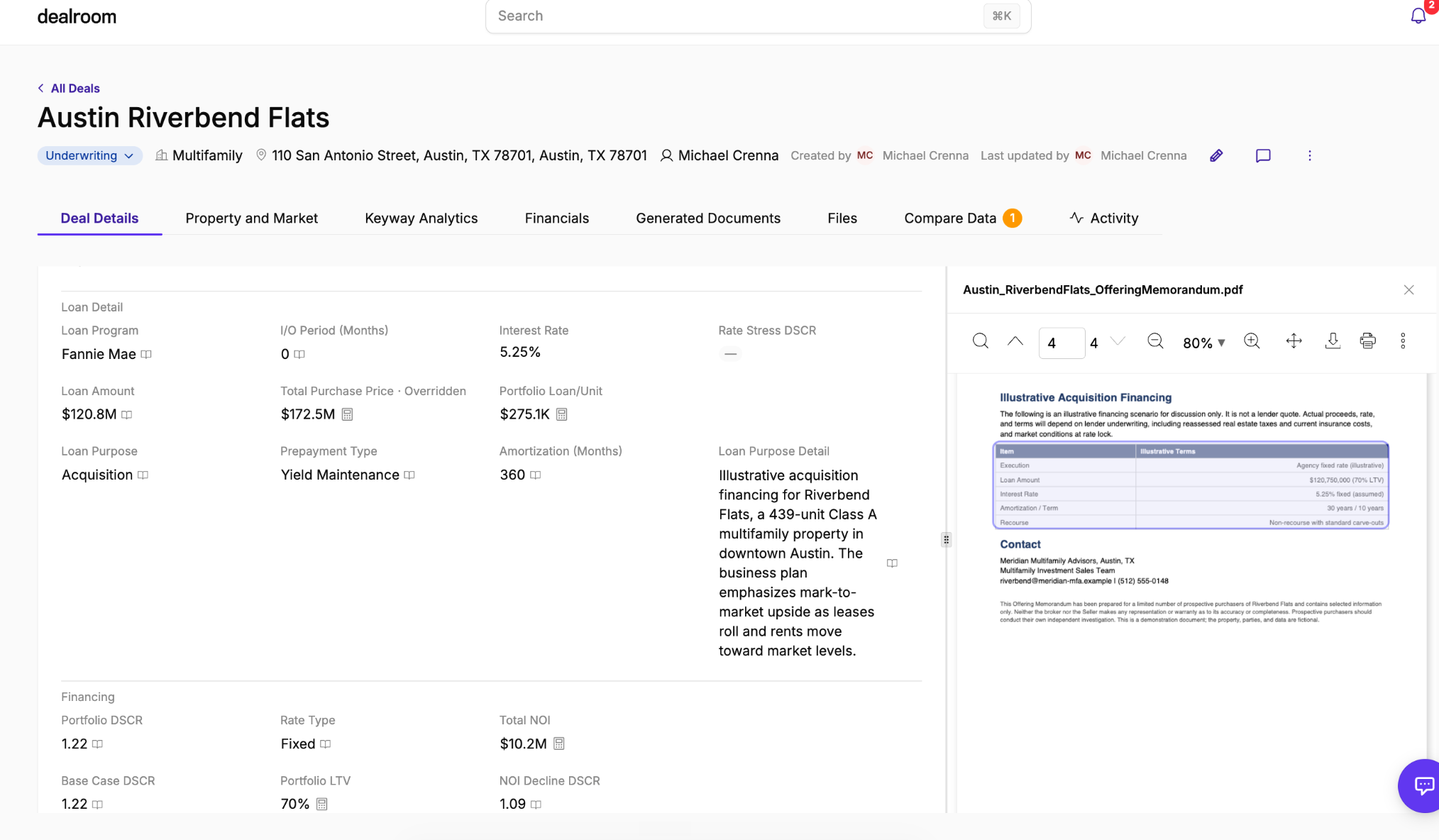
Instead of manually searching each document, reconciling information across files, and transferring data into credit materials, Keyway can extract and structure relevant information, link it back to its original source, and surface discrepancies for review before using that context to generate the loan narrative.
The underwriter can then review the information, validate the output, and make any changes rather than building it from scratch. That traceability matters in lending: the team can see where a figure came from, review the underlying source, validate the information, edit, and even co-work with others before it moves into the credit decision.
Keyway’s DealRoom gives lending teams a centralized workspace for each deal, connecting documents, data, and workflows in one place.
The same infrastructure can support different asset classes and be configured around agency-specific or lender-specific processes without forcing teams into a rigid system.
For community banks, banks, and CRE lenders, the bigger advantage is being able to pursue more opportunities without underwriting becoming a constraint on growth. This kind of infrastructure can expand what existing teams are able to handle while preserving the rigor behind every credit decision.
CRE debt markets are entering a period of greater activity and competition, with banks, private credit, debt funds, and other sources of capital all pursuing opportunities. At the same time, underwriting discipline remains critical as lenders navigate different asset fundamentals, capital structures, and risk profiles.
In that environment, the value of an agentic operating system like Keyway isn’t simply speed. It’s giving lenders the operating capacity to compete for more opportunities without lowering the standard of analysis behind each one.
The future of CRE underwriting isn’t about removing the underwriter from the process, but extending what each underwriter can accomplish while keeping professional judgment at the center of every credit decision.
How can AI be used in CRE underwriting?
AI can support CRE underwriting by extracting and structuring information from deal documents, reconciling data across files, identifying discrepancies, and helping generate credit materials. The underwriter remains responsible for reviewing the information and making the credit decision.
Can community banks use AI to scale CRE underwriting?
AI can help community banks process more deal information without increasing the manual workload associated with each opportunity. By automating document-heavy tasks, underwriting teams can spend more time on analysis, risk, and credit judgment.
What is agentic AI in CRE lending?
Agentic AI goes beyond answering individual prompts by working across documents, data, and workflows to complete multi-step tasks. In CRE lending, that can include organizing deal information, validating data against source documents, surfacing discrepancies, and preparing information for credit review.