
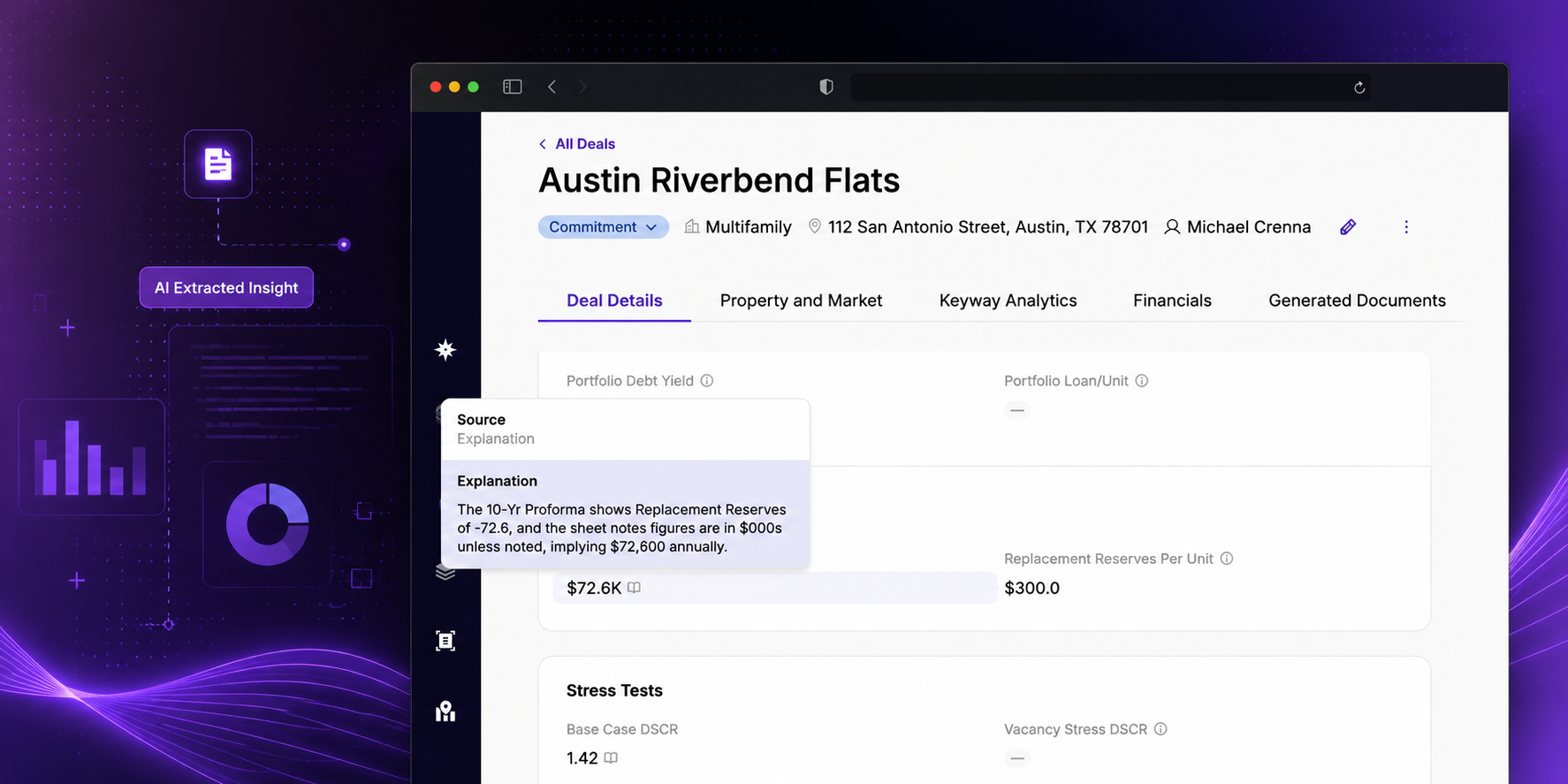
The average loan narrative still takes 3–5 days to produce.
Not because underwriting is complicated, but because commercial real estate still runs on disconnected documents.
Every deal brings the same pile of materials: offering memorandums, rent rolls, T-12s, appraisals, lease abstracts, financial models, and supporting files. Somewhere inside those documents is the information a lender, credit committee, agency, or investment committee needs to make a decision. The problem is that someone still has to find it, verify it, copy it, format it, explain it, and update it every time the deal changes.
None of that is really underwriting. It's data entry dressed up as work.
Keyway eliminates that manual work by generating complete loan narratives and IC memos directly from your deal documents in approximately 30 minutes. Better yet, every narrative stays connected to the live deal, so updates happen automatically as the transaction evolves.
A loan narrative is the written case for a commercial real estate loan. It brings together the property, borrower, financials, risks, valuation, market context, and recommendation into one structured document for review by a credit committee, lender, agency, or capital partner.
For acquisitions teams, the equivalent is often an IC memo: the internal document used to present a deal to an investment committee.
The audience may be different, but the workflow is nearly identical. Both require teams to turn fragmented deal information into a clear, decision-ready narrative.
A deal is never static. Loan amounts change, appraisals are updated, new rent rolls arrive, terms shift and assumptions get constantly revised. But the narrative usually lives in a Word document, separate from the underlying deal data.
That means every change creates a manual reconciliation exercise. Analysts have to find every place a number appears, update the language, re-check the math, and make sure the latest version is the one everyone is reviewing. And that's where mistakes are most likely to occur.
A stale DSCR. An outdated LTV. A rent roll figure that no longer matches the source. A committee question no one can answer quickly: “Where did this number come from?”
The issue is not the document itself; it’s really the document that is disconnected from the deal.
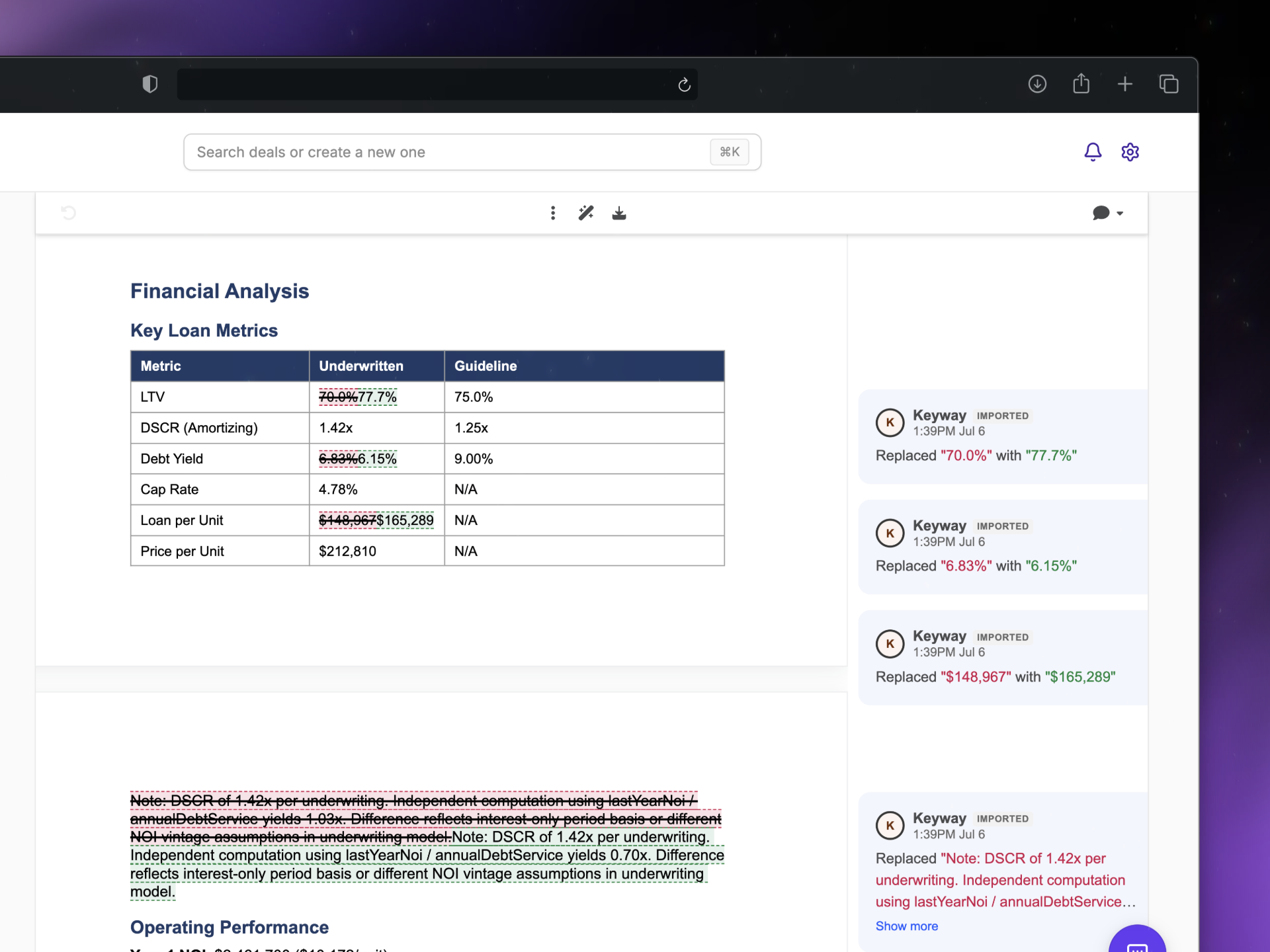
Keyway’s Loan Narrative & IC Memo Generator lives inside Deal Room, Keyway’s deal pipeline CRM. Instead of building a loan narrative or IC memo manually, users upload the deal documents they already have — OMs, T-12s, rent rolls, appraisals, lease abstracts, Excel files, PDFs, Word docs, and supporting materials — into one connected workspace.
Keyway then extracts and cross-references the relevant information and generates a complete loan narrative or IC memo in your organization’s format and language, including GSE-aligned narratives for agency lending use cases.
A process that typically takes 3–5 days can be reduced to approximately 30 minutes.
But speed is only part of the story.
The real difference is that the loan narrative or IC memo stays connected to the live deal record. When a loan amount, appraisal figure, lease assumption, or deal term changes, the affected sections update with it, including financial metrics, risk commentary, recommendations, and supporting analysis.
No more manual hunting through a document, no version drift, no stale memo quietly making its way to committee.

Most commercial real estate software helps teams create documents faster, but Keyway does something different. It turns loan narratives and IC memos into live, source-connected assets that evolve with the deal.
This means every number can be traced back to the document and page it came from. Every update stays connected to the underlying deal data. Every downstream output — the loan narrative, the IC memo, the committee package, future reporting — can be built from the same source of truth.
That matters because the cost of manual narrative work is not just time; it’s also capacity.
If a team can turn a 3–5 day process into 30 minutes, the same team can analyze more deals, move faster through committees, respond to borrowers sooner, and reduce operational risk without adding headcount. At scale, that can mean the difference between closing 20 deals in a quarter and pushing 23–25 through the same door.
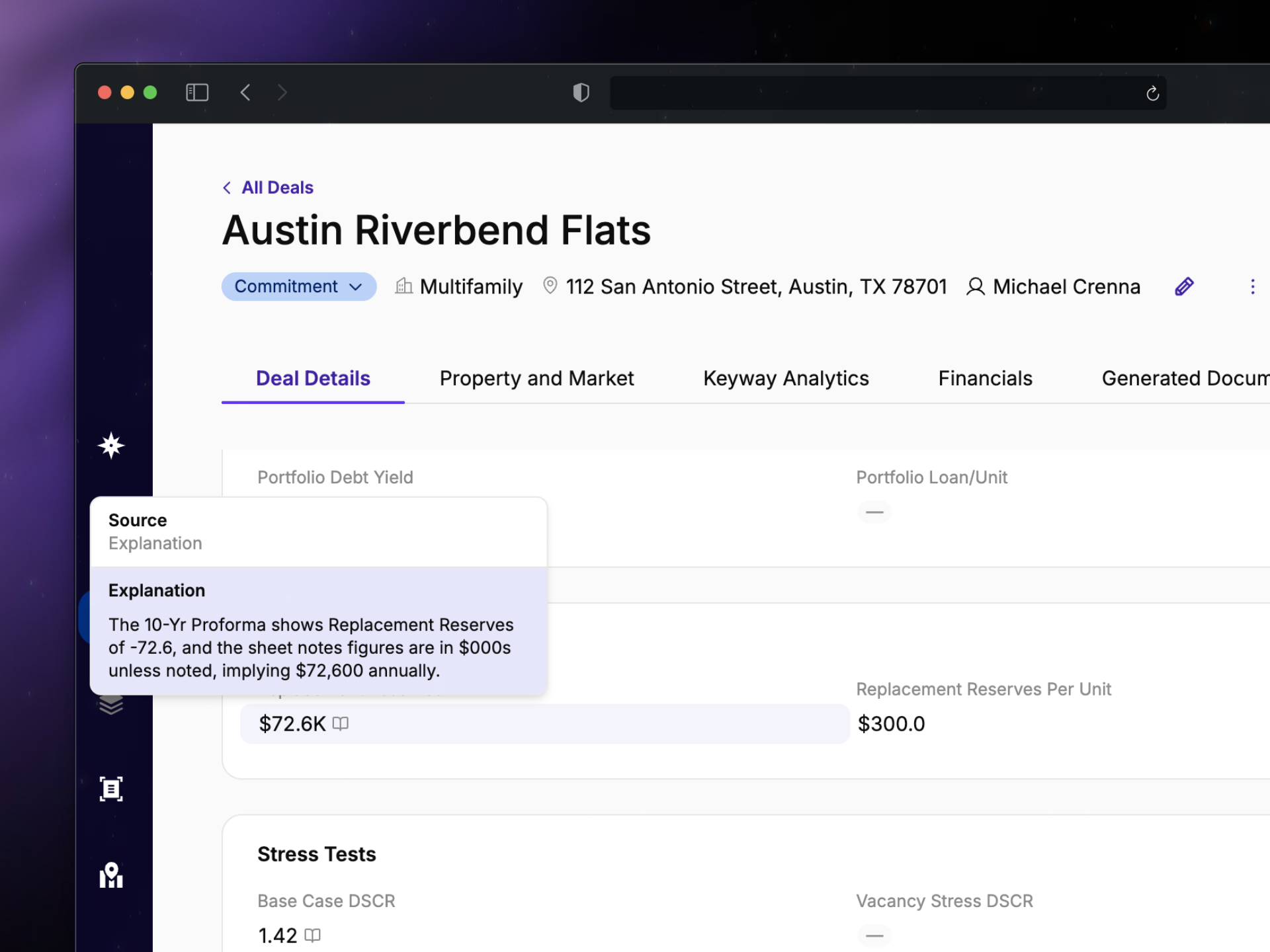
Keyway helps underwriting teams make faster, more confident decisions, but your experts still have the final say.
What Keyway removes is the manual work around that judgment: copying numbers, reformatting sections, reconciling versions, checking sources, and rewriting the same narrative every time the deal changes.
Analysts spend more time analyzing, credit teams spend more time evaluating risk, and committees spend more time making decisions.
That is the real value of AI in commercial real estate: not replacing expertise, but working as a strategic partner and giving professional teams the infrastructure to move faster, work more efficiently, and scale their business.
Bring us a property and its documents. We’ll organize the data, generate the loan narrative or IC memo in your own format, and show you how every update stays connected to the deal — live.