
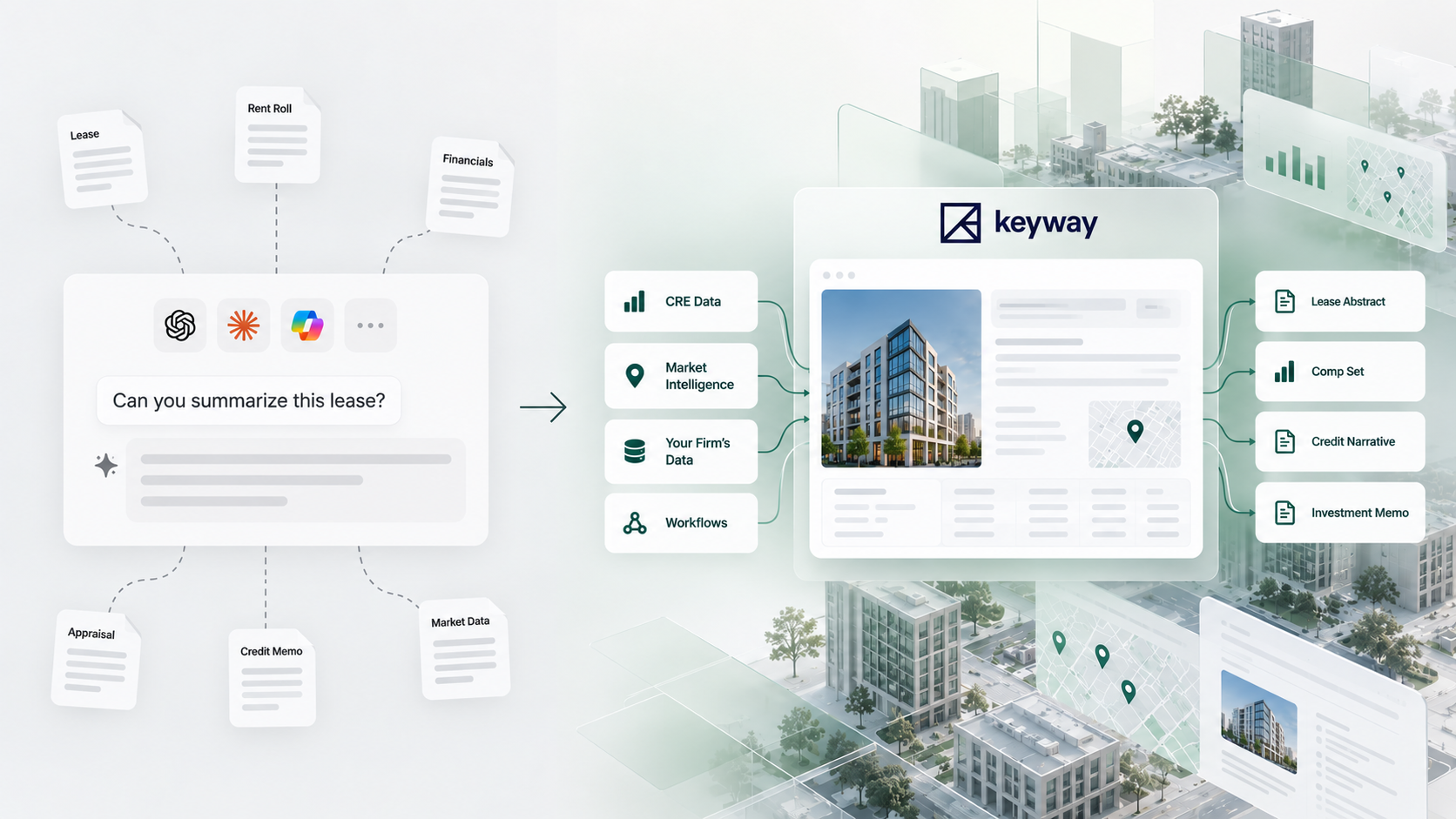
In our conversations with commercial real estate firms, one question comes up again and again: Why use a vertical AI platform like Keyway instead of Claude, ChatGPT, Copilot, or even building something in-house?
Frontier models have become remarkably good at summarizing leases, extracting information from PDFs, and answering complex questions. But commercial real estate work rarely ends with a prompt.
An acquisitions team may need to identify sellers, build comps, validate pricing, and prioritize opportunities. An asset manager might process hundreds of leases, trace values to their sources, and push results into existing systems. A lender needs to review deal documents, validate financial terms, and turn them into a credit narrative or investment committee memo.
For CRE firms, the difference between general-purpose AI and vertical AI isn’t simply the underlying model. It’s the industry context, workflows, validation, and infrastructure built around it.
CRE has its own terminology, financial frameworks, and relationships. Every firm adds its own underwriting assumptions, templates, processes, and institutional knowledge.
There’s also the data itself. Out-of-the-box AI models don’t come with the proprietary CRE data, rent comps, market intelligence, and other industry-specific information that can add critical context to an analysis. Keyway brings that data together with a firm’s own information, giving the AI a richer understanding of the market and the deal it is evaluating.
A powerful AI model is like a high-performance car engine: without the rest of the car, it won’t get you anywhere. In CRE, the surrounding system needs to understand which information matters, how documents and data relate, what requires validation, and what should happen next. That surrounding system is what we think of as the Keyway Harness: the layer around the underlying AI that brings together CRE-specific data, market intelligence, workflows, validation, and firm-specific context to make the model useful in real-world commercial real estate work.
That also includes knowing when something looks wrong. An NOI in a T12 may not reconcile with underlying income and expenses. Lease dates or rent terms may conflict across amendments. A loan covenant in a credit memo may not match the source documents. A plausible answer isn’t necessarily a reliable one.
This is where the Keyway Harness goes beyond the underlying model. By combining CRE-specific data and market intelligence with a firm’s own information and workflows, Keyway provides the context, validation, and source traceability needed to move from isolated AI tasks to reliable work.
For InterCapital Group, for example, that means using Keyway to generate relevant comp sets based on geography, asset type, amenities, and unit mix, while bringing rent data, effective rents, renovation status, and market signals into the same analysis. The result is a process that lets the team evaluate rent comps in seconds and save 20+ hours per underwriting.
As models become more capable and less expensive, access to AI intelligence itself is becoming more of a commodity. But cheaper tokens don’t necessarily make enterprise AI cheap.
Putting AI into production means connecting it to company data and systems, maintaining context, validating outputs, managing permissions and human review, and continually adapting as models and business requirements evolve.
The real build-versus-buy cost isn’t what a provider charges per million tokens. It’s the engineering, integrations, workflow development, and maintenance required to turn those tokens into reliable work.
Consider lease abstraction. One large asset manager is working today with Keyway to create structured lease abstracts in minutes rather than weeks, trace information to its source, and generate outputs formatted for its existing Yardi schema—reducing manual lease-review time by 90% and saving more than $100,000 annually in direct costs.
For CRE firms, AI isn’t simply an opportunity to make individual tasks faster. A more meaningful measure is how much more an organization can accomplish because of it.
Powerful AI is increasingly available to everyone. What won’t be universal is the ability to turn it into better decisions, more capacity, and more business growth. That’s the gap Keyway is built to close.
Vertical AI combines powerful AI models with commercial real estate-specific data, context, workflows, data structures, and validation.Instead of simply responding to individual prompts, it is designed to work within the processes and requirements of CRE organizations.
General-purpose AI can perform tasks such as summarizing documents, extracting information, and answering questions. CRE workflows often require additional context, source traceability, validation, integrations, and an understanding of how information relates across documents, assets, deals, and systems.
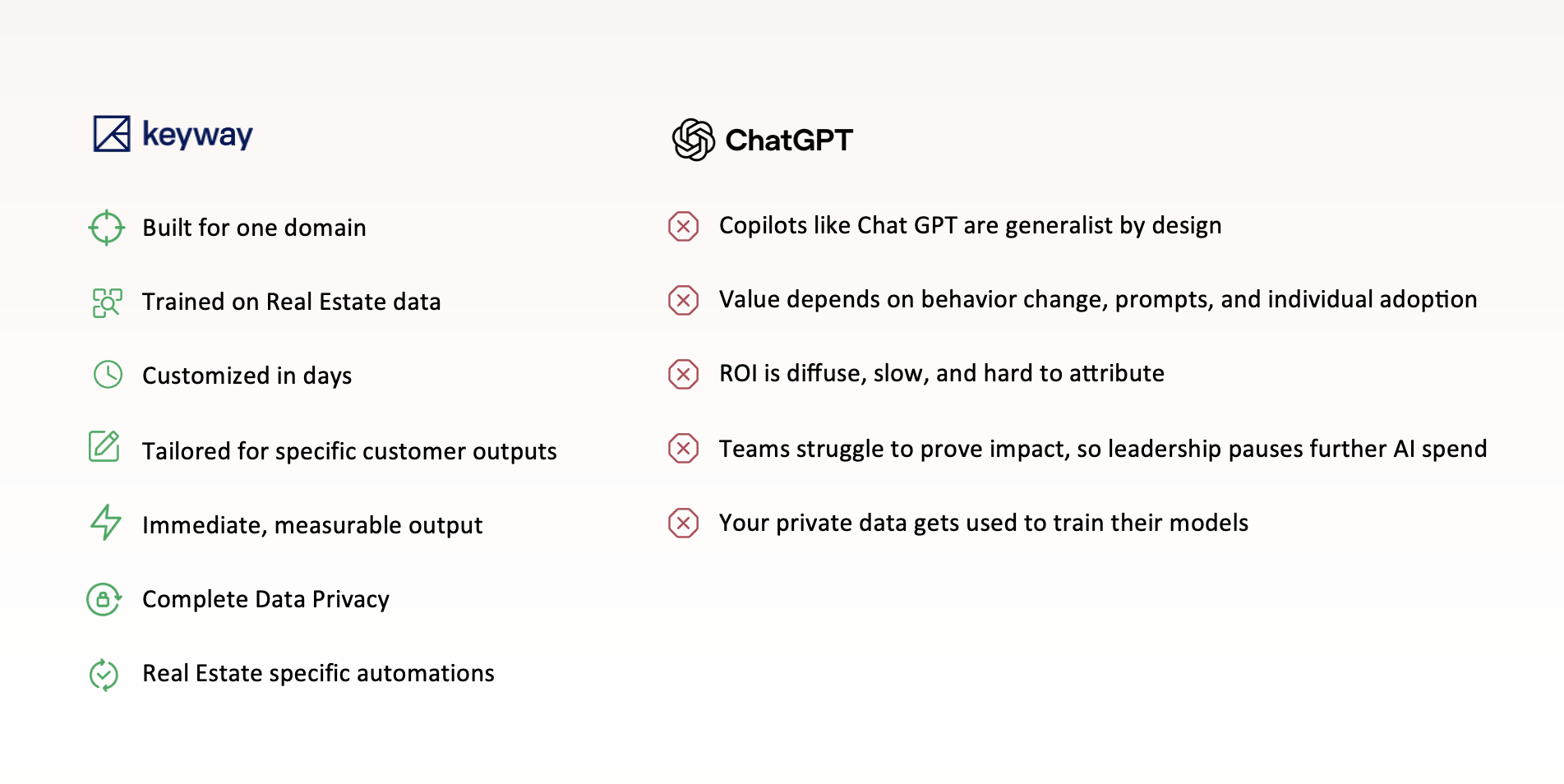
The answer depends on a firm’s resources and requirements. The comparison should account not only for model costs, but also for the engineering, integrations, workflow development, validation, testing, monitoring, and ongoing maintenance required to operate AI reliably.