
Commercial real estate is facing a cadre of factors that make proactive risk management essential in today’s economic environment. High interest rates, inflation, and global supply chain disruptions have all influenced how today’s real estate teams approach both risk and return.
Whether you’re an investor, asset manager, lender, broker or other real estate professional, historical data alone or traditional economic forecasting won’t help you navigate a volatile real estate market. Real estate markets can shift quickly, with assumptions about rent growth, cap rates, and underwriting becoming stale soon after they’re made.
AI plays a critical role in managing this uncertainty, playing a specific part in the way real estate teams manage data. From macroeconomic drivers to property-level metrics, AI can help you leverage data faster and more accurately than before. The result is real-time, more informed decisions to approach volatility proactively.
How AI Identifies Risks Early
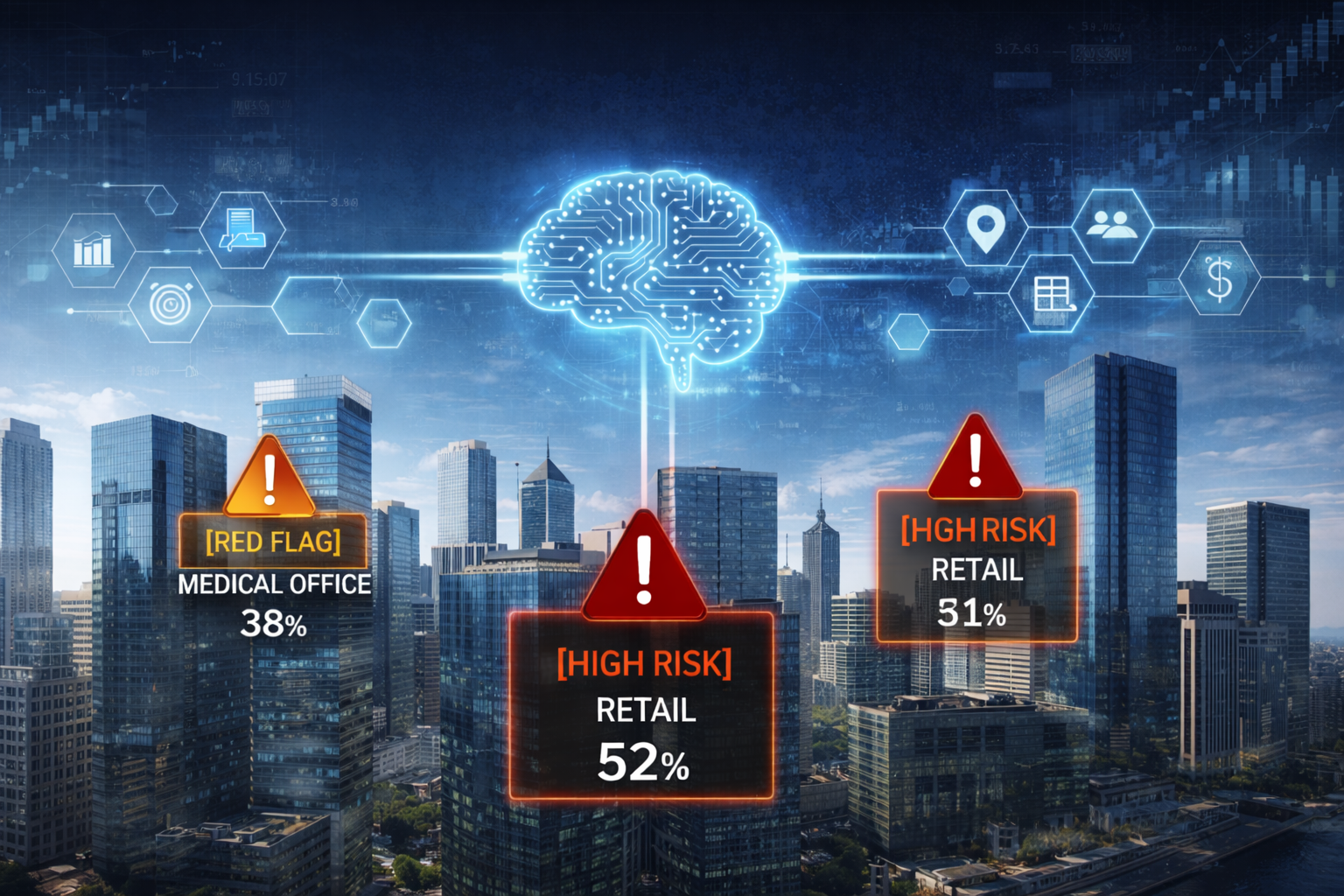
Asset managers know that real estate portfolios have inherent risks. Occupancy rates can decline, operating expenses can hinder returns, and a tenant’s financial condition can deteriorate. Traditionally, investors discovered these material changes after the fact once revenue declined or costs increased. AI can provide an early detection guardrail. By analyzing centralized public data sources as well as leases, market listings, zoning laws, and rent collection rates, for example, managers can target indicators of financial stress before any cash flow impact.
Machine learning also can be leveraged to analyze tenant behavior proactively. Are tenants making late rent payments? Are tenants complaining on social media about a property? AI and machine learning are effective in identifying patterns that can help real estate teams find risk factors that affect property performance.
AI-driven platforms like Keyway, have created solutions to centralize, standardize, and analyze lease data across portfolios. Rather than manually review hundreds of leases, which can lead to oversight and errors, asset managers can target problematic leases clauses, for example, before they cause damage to the business. The goal is to reduce risks before they escalate.
AI Helps To Balance Risk and Return
AI structures unstructured data to make it readable and actionable. In portfolio allocation, AI helps managers quantify the relationship between risk and reward. For example, portfolio allocation comes with inherent risks. How much capital should be allocated to a specific neighborhood or property?
AI can aggregate data such as market data, demographic trends, job growth, and asset performance to build more accurate, predictive modeling. The goal is to identify – backed by data – which markets are positioned for growth and which markets face economic challenges.
If data demonstrates that one market is facing slowing job growth and unattractive cap rates, predictive analytics can create more transparency for investors to shift to another market with stronger fundamentals.
How AI Stress Tests
Every portfolio manager can enhance stress testing with AI. Macroeconomic forces such as interest rate changes or interest rate fluctuations impact portfolio performance. AI can help managers test how their portfolios will react to adverse macro and micro conditions. With AI, you can run hundreds or thousands of scenarios based on real-time, public data. What does a 100 basis points change in interest rate mean for debt coverage service ratios? If a major employer close a factory, how are occupancy rates impacted?
Machine learning can elevate stress testing by combining one or more adverse events on portfolio resilience. What if rent growth slows and a local employer conducts a major workforce reduction? What if both interest rates and inflation increase? Asset managers can leverage AI to make better decisions proactively with deeper and faster insights.
Designing an AI Platform For Real Estate Teams
To design an effective suite of products that eliminates manual procedures in favor of an automated approach, real estate team should integrate:
• Aggregate market and property data with macroeconomic and demographic data to identify the best markets with superior returns.
• Use predictive models to allocate capital most efficiently based on rent growth, job growth, and absorption rates.
• Standardize rental comps based on public data to drive transparent comparisons across markets and neighborhoods.
• Convert unstructured lease documents into centralized and searchable data. Focus on lease terms with large financial impact like rent escalation, early termination rights, or maintenance responsibility.
Effective risk platforms empower real estate teams to implement and measure risk in real-time based on data.
Conclusion
From economic downturns to changes in tenant behavior, asset managers and investors know to expect to volatility in real estate. However, with the advent of AI, the ability to anticipate these changes more quickly and accurately has exponentially increased. Now, AI and machine learning help investors and asset managers to identify risks, scenario test, and make informed decisions based on predictive analytics. The result is moving real estate teams from a position of manual and mechanical to proactivity and power, resulting in early detection risk mitigation and enough time to pivot and execute quickly.







.jpg)